Xavier
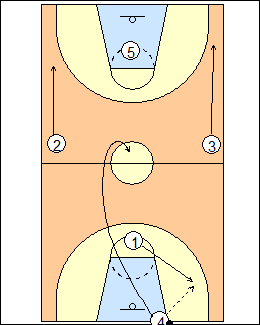 | 1 goxavier.com a) 1-Up b) 2-Up c) 2-Up Big d) 3-Up e) 4-Across Their philosophy is to use the fewest players possible in breaking a fullcourt press. The quickest way to keep a team from pressuring you is to get a couple of easy baskets. If you don't have the personnel to attack to score, get the ball safely out of pressure so you can execute halfcourt offence. You need to know what the defence is trying to achieve - if it's a turnover-based defence, simply not turning it over will frustrate them; if they are trying to increase tempo, then methodically break pressure with the pass. To give your team confidence in the press break, have the first team go against the second team. Also go 5 on 7 to put priority on crisp ball movement, cuts, and meeting passes. a) 1-Up This is great if your point guard can't be denied, clear out and space the other players in the frontcourt so you can quickly attack the basket or flow into halfcourt offence. 4 gets to the middle on a "J" hook-cut to be used as a screener or release pass. They also teach 1 to post up for the inbounds pass. See Press breaks - 1-Up, Shaka Smart, also Middle. (Post the point guard - 1 walks to post directly in front of the ball. If his defender is playing on one side or the other, 1 takes a small step at him to freeze him, uses an arm bar to hold him off if necessary, indicates a target hand, and moves opposite his defender, a pass should be easy. If the defender is fronting, 1 signals for a lob pass over the top, which should also be an easy pass.) |
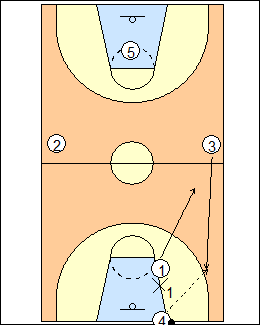 | 2 Pressure release - they allow 1 to post and work for three seconds before going to pressure release, 3 breaks back (a tough cut to defend), 1 is fronted (or the ball would have been inbounded to him), holds until 3 gets the inbounds pass, then sprints to the diagonal, there's no way X1 can catch him. Arizona - 3 v-cuts into his defender's path then back out. If 1 comes ballside he takes away 3's lane. Bill Self 1-3-1 - 3 flashes back and angles in to cut off his defender.  |
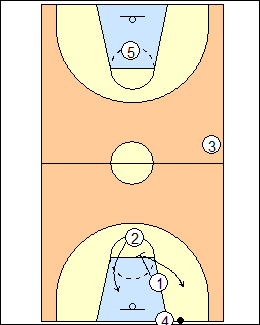 | b) 2-Up 1 screens for 2 who reads the defence and cuts to the corner and 1 rolls to the basket (red option), or 2 cuts to the basket and 1 comes back to the ball (green option, shown). This works well against switching defences, and is used anytime they need to inbound the ball safely to get fouled or run clock. (On an inbounds pass to one guard, the other guard cuts middle) LSU Set - if 1 is face-guarded he may screen for 2. coachesclipboard.ca - 2 starts at the top of the key (making it easier to go towards the ball), 1 starts in front of the ball and screens with his back to the ballside corner, 2 and 1 go opposite. Bill Self 1-3-1 - 2 starts at the second marker, drop pivots and screens for 1, then steps back to the ball. 1 and 2 can stack. Double Middle - 1 and 2 stack and break opposite, screen for each other and break opposite, or one player breaks and the other stays in the middle. Hofstra - 1 and 2 stack, screen for each other and break hard opposite. |
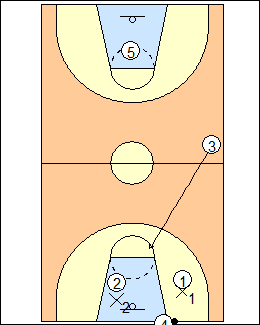 | 4 Pressure release - if 1 and 2 are fronted, 3 breaks hard to the ball, 1 and 2 hold until the catch, then they are off to the races. See Press breaks - Old Dominion regular, Canada Basketball, Falcon. Double Middle - 3 breaks back along the sideline. The pass to 3 is preferred if the press looks to trap the first pass (an on-ball press). Inbound the ball to 1 or 2 against an off-ball press (2-2-1 or 1-2-2). Hackenberg 2-up - a sideline flash by 3 is the primary option against a 1-2-1-1. Bill Self 1-3-1 - against a "hot" press you don't want to inbounds to the guards, they are decoys. On a pass to 3 flashing back on the sideline, the nearest guard cuts 45 degrees to the sideline, the other guard follows to the middle always ahead of the ball. Also see Press breaks - Hofstra (Blue, option 4), Dave Odom (Long corner), Atkins regular. Canada Basketball - Press Break - 3 starts in the middle of the floor (a tandem with 5), and stays in the middle. On a pass to 3, 1 and 2 go hard up the wings and 4 trails. |
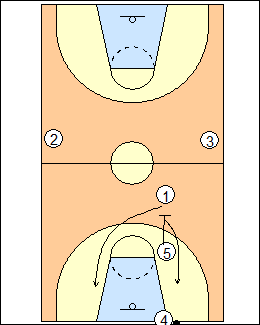 | c) 2-Up Big Another 2-up look brings 5 back to help break pressure, as a lot of teams are reluctant to bring their big away from the basket. 1 cuts off the screen, 5 comes right back to the ball and is usually wide-open if X5 helps on the cut. 1 can get open every time by running nose-to-nose with 5 and making the proper read. See Press breaks - Arizona, Utah, Baylor, also Hubie Brown. |
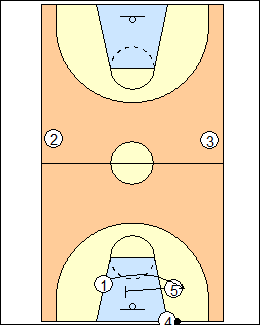 | 6 Pressure release - 5 re-screens for 1, very difficult to guard twice. Rick Majerus - always look to bypass with the wings, catch butt to the sideline. |
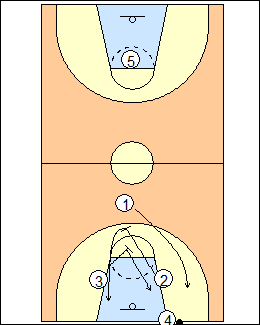 | d) 3-Up The oldest trick in the book, it's hard to guard. 2 screens for 1, 3 screens for 2 then steps to the ball. |
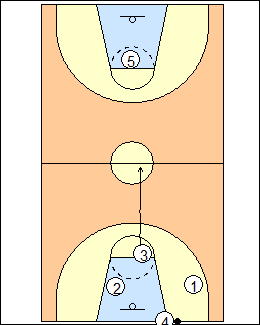 | 8 Pressure release - designate 2 or 3 to break long after they screen, often 3 is wide open. |
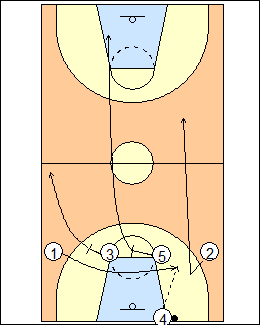 | e) 4-Across Great if there is a defender on the inbounder and they are trapping the first pass. 2 over the top is the first look, they're probably going to hit 1 (make sure he doesn't run to the dead corner). See Press breaks - 4-across (Option 3), Atkins Louisville invert. Variation - 5 screens then stays as a release option (or starts long and doubles back), see 1-4 Set, also 1-4 Press Break (Basketball for Coaches). |
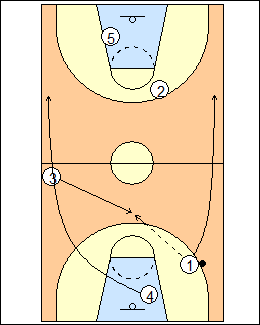 | 10 3 flashes to the ball for a pass, 4 and 1 run wide. Bill Self - on a pass to the middle, the trailer runs wide opposite, the passer becomes the new trailer. 4-across (Double screen) - 3 can break back to the middle for the inbounds pass. |
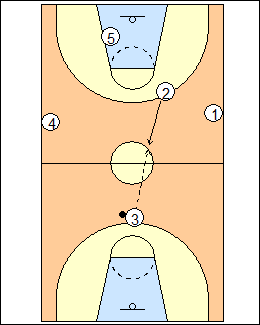 | 11 If needed, 2 can flash to the ball, look to attack with 5 at the rim and 4 and 1 wide. |
This page was made with Basketball playbook from Jes-Soft