Transition Basics
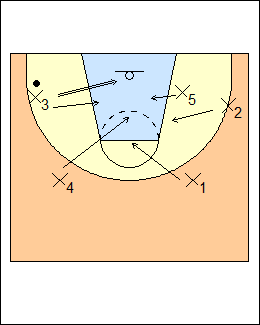 | 1 The goals of defensive transition (converting) are to protect the basket and slow down the ball. By default, all attackers crash the boards on a shot (shown), sprint back on a defensive rebound and pick up their checks. Against a fast-break team, more systematic transition defence can entail - one or more safeties who sprint back on a shot to protect the basket - picking up the ball early to slow it down - jamming the defensive rebounder, delaying an outlet pass - defending the trailer (defensive rebounder) below ball level with the jammer, providing help on the ball - covering the wing area to defend a head-man pass up the sideline. Even greater pressure can be applied by - denying an outlet pass to the point guard, slowing down the break by forcing a pass to another player - trapping on an outlet pass - trapping the defensive rebounder. Mike McNeill - if you jam the rebounder you must be able to slow the ball down once it gets out. If falling back into a 1/4-court zone defence, he wouldn't mix the two, just sprint back, set up the defence. See Defence - Defensive transition, also Transition - Lemanis 5 on 5, Woodley, Defending - Raptors 5 on 5 post entry. |
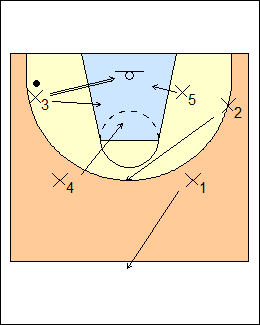 | 1) Man-to-man transition When team X shoots, X3, X4, and X5 crash the boards in a rebounding triangle, X1 is the long safety, getting back to halfcourt on the shot, X2 is the short safety, getting above the foul line, or above the top of the three-point line if a shooter. X2 can go for long rebounds out top. Defenders pick up their checks from these positions (X2 guards the opposing point guard), X3, X4 or X5 can jam if their check gets a defensive rebound, delaying an outlet pass, otherwise they sprint back. Variations - X4-X4-X5 sprint back on a defensive rebound (do not jam a defensive rebounder) - X2 also sprints back on a defensive rebound (does not pick up the ball early) - both X2 and X1 get back to halfcourt on a shot Mike MacKay - go to the boards if you are below the foul-line extended, otherwise get back. Allison McNeill - send 3-4-5 to the boards, the short safety contains the ball so the bigs can sprint back (without first jamming a rebounder). |
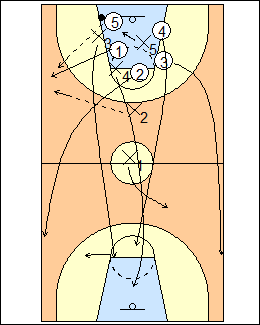 | 3 Here 5 gets the defensive rebound, so - X5 jams then matches up with 5, below ball level - X3 and X4 sprint to build the defence, the first back releases long safety X1 to protect the basket, then they find their checks - short safety X2 takes the outlet pass to 1, tries to contain the ball and keep it to the sideline - once released, X1 finds her check, here 3. If X1 can't release because of a rim run (here by 4), X4 and X3 will have to match up with remaining attackers (see match-up options, below). If 1 or 3 gets the defensive rebound, X3-X4-X5 sprint back to find their checks. Ken Shields - the biggest of the two sprinters releases the safety and protects the basket, the safety takes the first open man up the sideline. coachesclipboard.ca - the first big back releases the safety. Option - the sprinters set up a tandem before matching up. Lemanis - nail spot (middle of the foul line) - the player that gives help to the player covering the ball. Chris Oliver - we call this the 'slant' spot, we force the ball middle into this slant. The slant is usually the player covering the inbounder or a trail player |
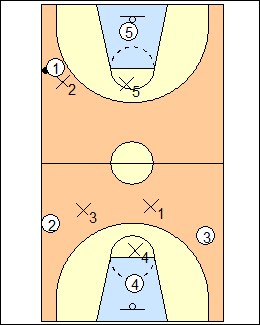 | 4 Basic fullcourt pressure, X5 defends trailer 5 at ball level, providing help on the ball. Progression - X2 denies an outlet pass to 1. Basketball Canada - deny a pass to a primary receiver (point guard), forcing an outlet pass to another player. Have a guard pick up the ball at centre and put light pressure on the ball to slow it down. Bob Hurley - they will deny the outlet to force the other primary ballhandler to come back to receive the ball. Andrej Lemanis - get the ball under control as early as possible, slow it down, keep it on a side and in front. Kevin Eastman - against pass-ahead teams, stop the first pass upcourt; against dribble-advance teams, cover the ball and get back to the elbows.  |
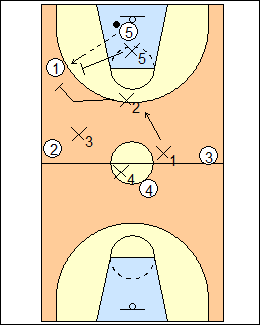 | 2) Trapping options Aggressive fullcourt pressure, e.g. when losing. a) Trap the outlet pass The jammer can follow the outlet pass to trap with X2, get the ball away from the point guard. Here X3 and X1 are interceptors, X4 is safety. Hoop Tactics Transition Defence - Green - safety X1 moves toward midcourt on a shot, four players offensive rebound, the closest jams the rebounder then sprint releases on an outlet pass to trap O1, the primary ballhandler. |
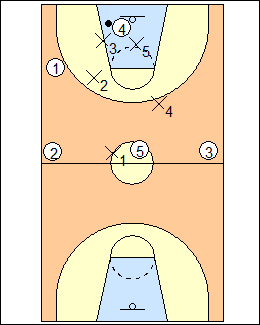 | 6 b) Trap the rebounder The two closest defenders trap the rebounder, here X3 and X5 trap 4, X2 and X4 are interceptors, X1 is safety (a 2-2-1). X2 takes away 1 (or covers ballside, or is always on the left). Can be used even if 1 or 3 gets the defensive rebound (X2 or X1's check). Doug Porter - the goal is maximum pressure at all times, the two closest defenders trap the rebounder. |
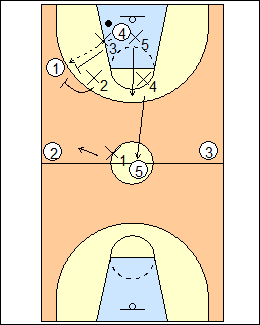 | 7 X3 or X5 can follow an outlet pass in their direction to trap, here X1 and X5 are interceptors, X4 is safety. Heath Millar - optionally send four players to rebound, which will speed up the game and make it hard for the other team to outlet pass, but will leave you vulnerable if the other team is organized in transition and can get a quick outlet. Grinnell 1-2-2 - on a shot, all attackers rebound except the shooter, who rotates to the top of the key looking for a kick-out pass for a 3-point shot. After a miss, the shooter can't move up from the top of the key until the trailer (safety) has crossed his path getting back. |
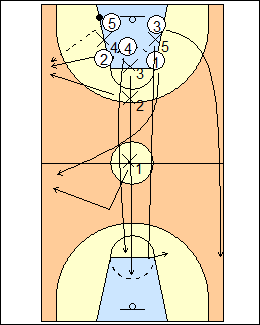 | 3) Match-up options Instead of trying to pick up their checks, defenders match up with attackers, X2 covers whoever gets the outlet pass. Bob Hurley - if the rebounder can put it on the floor and bust out, this will cause plenty of match-up problems. a) Jam with X3, X4 or X5 Ken Shields - the closest man pressures the outlet passer on a miss or the inbounds passer on a make. The biggest of the two sprinters releases the safety and protects the basket, the safety takes the first open man up the sideline. Chris Oliver - the first post back releases the "get-back" player (usually the point guard), who covers the weakside wing. See Defences - AIS defensive transition, BNSW transition, Transition - 5 on 5 defensive transition. c) Jam with X4, X1 covers ballside (shown) X4 is the jammer, the first of X3 or X5 to get back releases long safety X1, who covers the ballside sideline. |
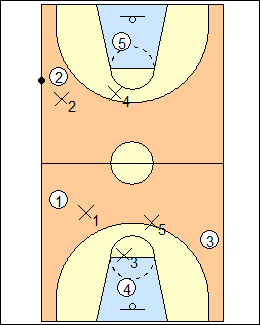 | 9 X4 defends trailer 5 at ball level, providing help on the ball. See above for trapping options. d) Guard your defender All 5 players guard the player who was guarding them when a shot goes up. Ralph Miller - use an automatic pick-up rule to control the fast break- guard the man who was guarding you when possession was lost, providing coverage on the rebound, the outlet pass, and as the offence attempts to fill the lanes. (Option) - use the same pick-up rule with safeties. See Defence - Tagging up (all 5 players offensive rebound). Matching up can also be used to press after a made basket, see Defences - BNSW transition, Match-up press. |
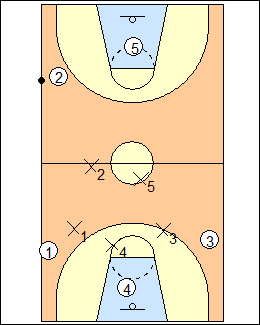 | 4) Sprint back Against a very good fast-break team, or when protecting a lead, make them play 5 on 5, progressions: - X3-X4-X5 all sprint back on a defensive rebound (don't jam the defensive rebounder) - X2 also gets back on a defensive rebound (does not pick up the ball early) - X1 and X2 are both long safeties, sprinting back to halfcourt on a shot, one on each side, pick up and contain the ball at halfcourt (X2 does not take an outlet pass) - X1-X2-X3 all get back on the shot, only X4-X5 offensive rebound. Tusculum - two guards get back on the shot, remaining players sprint back. coachesclipboard.net - assign two guards to retreat on the shot, one on each side of the centre circle, the ballside guard picks up the ball, the other retreats to the paint. Bob Hurley - he doesn't believe in jamming the rebounder, he wants running to be instinctive. Don Kelbick - all five guys sprint back (don't play the ball unless you have a great defender), find the ball and make sure it is covered, then find a man. Breakthrough Basketball - the second the other team gets the ball, your players need to turn, sprint back to the opposite end and find their man. Seth Miller - send three to the glass, one guard (fullback) sprints back to the paint, another guard (halfback) sprints to the centre circle. On an advance pass up the sideline, the fullback moves out to stop the ball while the halfback drops into the paint to protect the basket. If there is no advance pass, the halfback picks up the ball and begins to level off the ballhandler until the rest of the team gets back. Dwane Casey - on the raise of a shot, three guys get back, 3 can rebound if he is in the paint. Sprint to halfcourt, turn and point to your matchup. Don't force baseline in transition, all the help is in the middle of the floor. The second big beats his man back and gets to an elbow ready to help. Ken Shields - contain the dribbler, force sideline, establish an early strongside. Lock Left Like Kobe Bryant - force left in the fullcourt. Matt Woodley - won't pick up the ball too early, a guard stops the ball maybe around the 3-point line. The days of having a guy try to stop the ball at halfcourt are gone in his opinion. The first post guards the rim, the second post loads to the ball, helps get it under control. The rest of the guys build a wall. |